

Types of Bank Fraud: Common Scams, Real Examples and How to Protect Your Accounts
Last updated on November 6, 2026
Bank fraud occurs when criminals use stolen information, deception, false promises, and other techniques to illegally access money or accounts. California Credit Union uses the latest technology to safeguard your personal and financial information.
- Common types of bank fraud include phishing, SIM swapping, check fraud and ATM skimming.
- Bank fraud is increasingly common because banking is mostly digital and mobile and AI is getting better at creating deepfakes to deceive people.
- California Credit Union works hard to protect our members’ personal and financial information through a wide variety of security policies and technology, and we also conduct routine and regular security analysis on our network.
- As a reminder, we will never ask you for personal account information via email or text message requesting you to provide personal secure information, such as a PIN, account number, social security number or password
Discover the main types of bank fraud and how to best protect yourself.
Bank fraud occurs when criminals use stolen information, deception, false promises and other techniques to illegally access money or accounts. Fraudsters don’t just use these tactics to access checking and savings accounts; they can also open fraudulent loans, compromise your data and impact your business. Examples of common types of bank fraud include identity theft, phishing, account takeover, wire fraud and check fraud.
Key Takeaways
- Bank fraud is when criminals illegally gain access to bank accounts and funds through methods such as deception and stolen information
- Common types of bank fraud include phishing, SIM swapping, check fraud and ATM skimming
- Bank fraud is increasingly common because banking is mostly digital and mobile, and AI is getting better at creating deepfakes to deceive people
- If you’re the victim of bank fraud, you should report it to your bank or credit union and file a report with the Federal Trade Commission (FTC) and the Internet Crime Complaint Center (IC3). The IC3 is run by the FBI and is the central hub for reporting cyber-enabled crime. You can contact California Credit Union at (800) 334-8788 or [email protected]
Each year, thousands of people fall victim to bank fraud. From credit card theft to phishing scams and account takeover, criminals use various strategies to target your accounts and the money in them.
It is important to understand the difference between a fraud and a scam too. Fraud occurs without someone's authorization or knowledge; scams are designed for your active (though tricked or deceived) participation. This difference also affects how a consumer can recover their money.
In cases of fraud, consumers can be protected through federal laws like Regulation E that limit your liability for fraudulent electronic fund transfers including debit cards, ATM transactions, direct deposits and P2P payments like Zelle. If reported within two business days, your maximum liability is only $50. With scams though, because the transaction was authorized or the information was shared voluntarily, there are less protections towards your liability and fewer options for compensation.
Understanding how bank fraud works and some of the most common types to watch out for can help protect yourself from internet scams. If you're a California Credit Union member and believe you're a victim of fraud, a scam or have been the recipient of suspicious communication, please contact [email protected] or call us at (800) 334-8788.
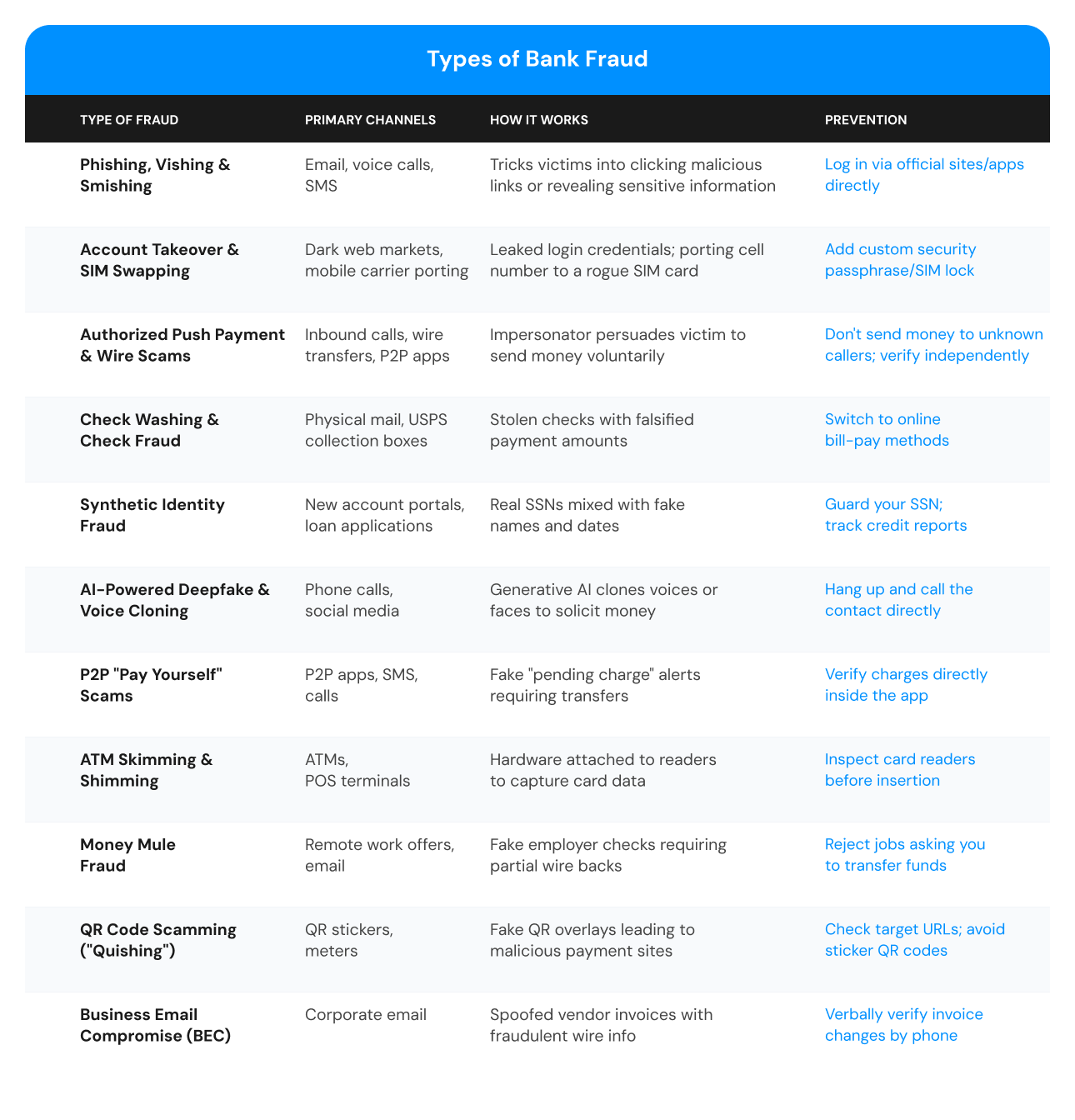
The Most Common Types of Bank Fraud (With Real Examples)
Constant advances in financial technology mean bank fraud isn’t just a financial issue; it’s a cybersecurity issue. Learn more about some of the most common types of bank fraud to make sure your accounts are secure.
Phishing, vishing, and smishing scams
Phishing, vishing and smishing scams are some of the simplest and most common forms of bank fraud. These attacks occur when someone impersonates a financial institution to coerce you to click a link or hand over your information. Each attack comes through a separate channel format:
- Phishing: Email
- Vishing: Voice calls
- Smishing: SMS
For example, you might receive an email reporting a fraudulent purchase and asking you to log in to confirm it. The link takes you to a fake website that steals your information.
According to the Federal Trade Commission, people reported losing $3.5 billion to imposter scams in 2025 alone. If you receive a call, text, or email from your financial institution, ignore it. Instead, go to your bank’s website and log in from there or call the official listed number.
Account takeover (ATO) & SIM swapping
Account takeover is when criminals gain access to your account, allowing them to drain your savings account. Criminals can buy stolen login credentials from the dark web or transfer your mobile number to a rogue SIM card to bypass 2FA.
In 2024, a Chatsworth man lost $21,000 in a SIM swapping scam when Spectrum allowed criminals to transfer his mobile number to a new phone. With access to his phone, criminals were able to intercept text back codes and access his account.
You can protect yourself from ATO and SIM swapping attacks by checking if your accounts have been impacted by data breaches and contacting your mobile carrier to add a passphrase or SIM lock.
Authorized push payment (APP) & wire scams
Authorized push payment (APP) & wire scams involve tricking people into sending money through wire transfers or payment apps like Zelle.
Tech support scams are some of the most common APP scams. Someone calls, impersonating tech support and saying your device is compromised, asking you to send money so they can fix the issue. The issue is never fixed, and in some cases your credit card information may be compromised.
Avoiding APP & wire scams is as simple as not sending money to anybody you don’t know. If somebody you don’t know contacts you asking you to send money, ignore it.
Check washing and check fraud
Check washing and check fraud is when people steal paper checks, erase payee details and rewrite the payment amount, stealing checks that were intended for someone else.
Thieves may target US Postal Service collection boxes and residential mailboxes, collecting a series of small checks to fraudulently cash. You might notice checks clearing at unexpected times.
You can avoid check washing by switching to electronic payment methods.
Synthetic identity fraud
When scammers use real Social Security numbers with fake names and birthdates to take out loans and open new bank accounts, it’s known as synthetic identity fraud. This type of fraud is hard to detect because the “person” who opened the account doesn’t exist under that name or birthdate.
Monitor your credit history regularly and keep your SSN safe to avoid these scams.
AI-powered deepfake & voice-cloning fraud
AI-powered fraud is becoming more common as AI evolves. Scammers use generative AI to create deepfakes that look and sound like family members or bank officials to coerce victims into transferring money.
Scammers can use social media to find images and audio of your family members, then use that to generate a fake phone call saying there’s been an emergency and you need to send money right away.
According to a Consumer Federation of America report, consumers reported $893 million in losses due to AI-enabled crime in 2025.
If you receive an unusual call, hang up and call the person directly to verify their identity before sending any money.
Peer-to-peer (P2P) payment scams & “pay yourself” scams
Scammers impersonate your bank, alerting you that you have a pending charge (which is fake) and helping you “cancel” the charge by sending money to your mobile number. The mobile number is linked to the scammer’s account, so they receive the money.
You might receive a text or phone call alerting you of a fraudulent purchase and guiding you through a step-by-step process for canceling the purchase using Zelle.
If somebody calls to alert you about a pending charge, hang up and check your bank account to verify the charge exists.
ATM skimming, shimming, & card cloning
Skimming attacks have been increasingly common in recent years. Scammers install devices that read and steal card data when you’re using the ATM or paying at the register. Skimmers read magnetic stripes while shimmers read chip data.
During a 2026 operation in the greater Los Angeles area, federal agencies found 17 card skimming devices and removed them, preventing an estimated $17.7 million in fraud.
Protect yourself from skimming by looking closely at ATMs and card readers before using them.
Money mule & first-party fraud
This type of fraud happens when account holders allow their account to be used for illicit funds.
For example, a fake employer might offer you a work-from-home opportunity and send you a check. Fraudsters then ask you to send a portion of the money through a wire transfer, promising you money for transferring the funds.
If someone offers to pay you for simply transferring cash from one account to another, it’s almost certainly a scam. An offer seeming too good to be true is one of the classic warning signs of scams.
QR code scamming (“quishing”)
You can use QR codes for many types of payments, and you might see them on parking meters or restaurant tables. Scammers take advantage of this system by placing their own QR codes over legitimate ones, causing you to send money to the wrong person and compromise your debit card security.
Avoid scanning QR codes that aren’t printed directly on parking meters, and check the website URL before entering any payment information.
Business email compromise (BEC) & vendor invoice fraud
Some scammers target business email accounts or spoof accounts to trick vendors into sending payments to the wrong bank account.
A scammer might hack or spoof an accounts payable email account, sending an updated invoice to vendors with new payment details. The vendor sees the legitimate email address and sends the payment to the fraudster.
Vendors should keep an eye out for unexpected changes in invoice instructions and signs of spoofed email addresses before sending payments.
Why Is Bank Fraud on the Rise?
Bank fraud is on the rise for several reasons, but they all tie back into the technological advancements we’ve made in recent decades.
Most banks have made the switch to mobile-first and digital-only banking, making it easier than ever to access accounts remotely. If your account information is compromised, your money is too.
AI tools have also advanced rapidly, allowing fraudsters to generate accurate deepfakes that look and sound like bank officials and family members.
Smart money habits aren’t just about saving and spending wisely; focusing on account security is more important than ever.
Wrapping Up: Protect Yourself Against Banking Fraud
Having a basic understanding of these scams and how they work, plus a little caution goes a long way when it comes to protecting yourself against bank fraud. If you are a victim of bank fraud, you can report scams to the Federal Trade Commission. You should also file a complaint with the FBI Internet Crimes Complaint Center.
At California Credit Union, your security is our top priority. We are committed to providing you with a safe banking experience and educational information to help you protect your identity, and one of our top priorities is to protect the privacy and security of your personal information. From this we offer a robust suite of security services, all aimed at protecting you, your money and your peace of mind.