
How Much Should I Have in Savings? Average Savings By Age
Last updated on June 11, 2026
Learn how much money to keep in savings.
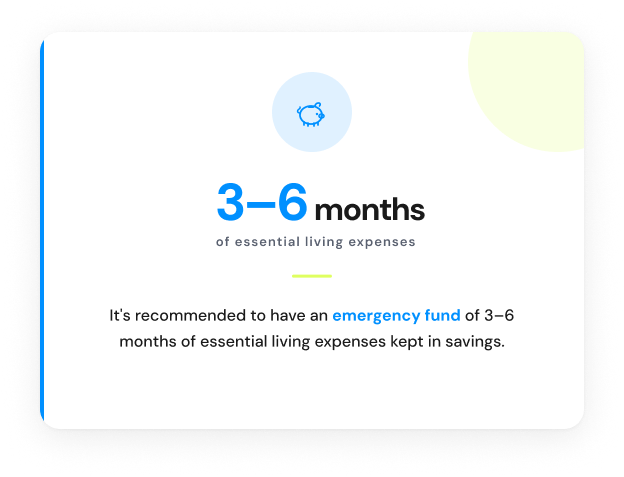
It’s recommended to have between 3 and 6 months of essential expenses saved in an emergency fund, which can be used to cover housing, food, transportation and other living expenses should you or your partner face an adverse life event like a medical emergency or job loss. It’s also recommended to have a separate savings account for retirement, and the amount you save depends on several factors like age, income and financial goals.
In this guide, we’ll break down how much you should have in savings based on your situation, how to calculate your ideal emergency fund, savings recommendations by age and where to store your savings. Whether you’re just starting to build your savings or reassessing your financial plan, understanding the right amount to save can help you make more confident financial decisions.
Key Takeaways
- Most people should aim to keep 3-6 months of essential living expenses in savings to help cover emergencies like job loss, medical bills or unexpected repairs
- Savings needs often change with age and lifestyle. Households between the ages of 35 and 54 generally have the highest monthly expenses, which can increase recommended emergency savings amounts
- Savings accounts, high-yield savings accounts, money market accounts and share certificates can all help support different financial goals depending on how quickly you may need access to your money
- Keeping emergency savings in a dedicated savings account at a credit union like California Credit Union can help separate long-term savings from everyday spending while still providing accessible funds when needed. Open An Account Today
How Much Money Should I Have in Savings?
How much money you should have in savings depends on several factors, such as your age, income, expenses, debt, career stability and financial priorities. A general rule of thumb is to have an emergency fund of 3-6 months of essential living expenses in savings, which can cover essential expenses like housing, food, transportation, utilities, healthcare and other household expenses should an adverse life event like the loss of a job impact you or your family.
Use our free retirement savings calculator to ensure you have enough money saved to fund your retirement years.
Where Should You Keep Your Savings?
The best place to keep your savings depends on your financial goals, how quickly you may need access to your money and whether you want to prioritize accessibility, growth or long-term stability. Below are some of the common types of savings accounts:
- Regular savings account: A traditional savings account can be a good option for emergency funds and short-term savings goals because it provides easy access to your money while keeping funds separate from everyday spending
- High-yield savings account: A high-yield savings account typically offers higher interest rates than standard savings accounts, helping your money grow faster while still remaining accessible for emergencies or planned expenses
- Money market account: Money market accounts often combine savings features with limited check-writing or debit access, making them useful for people who want flexibility while still earning compound interest on their balance
- Share certificate or certificate of deposit (CD): A share certificate is offered by credit unions, while a CD is offered by banks, but both work the same. Both typically offer fixed interest rates in exchange for keeping your money deposited for a set period of time. They can work for longer-term savings goals when you don’t need immediate access to funds
- Retirement accounts: A retirement account, such as a Traditional or Roth IRA, 401(k) or another employer-sponsored plan, is designed for long-term savings and investing rather than emergency funds, but they play an important role in building overall financial security, especially for retirement
Tips for Building Your Savings
Growing your savings balance can feel overwhelming at first, but small, consistent habits can make a meaningful difference over time. Here’s how to get started:
- Automate your savings: Set up automatic transfers from checking to savings to save consistently without needing to think about it each month
- Create a monthly budget: Track income and expenses to identify unnecessary spending and free up money for savings goals
- Start with small goals: Building an emergency fund can feel more manageable when you begin with smaller milestones, such as saving your first $500 or $1,000
- Reduce nonessential spending: Cut back on discretionary purchases, such as takeout, subscriptions or impulse shopping, to create additional room in your budget for savings
- Separate savings by goal: Consider keeping separate savings accounts for emergencies, travel, holidays or home repairs to make it easy to stay organized and avoid overspending
- Increase savings when income grows: Redirect part of a raise or additional income toward savings to build financial security without dramatically impacting your lifestyle
- Pay down high-interest debt: Reduce high-interest credit card balances and other debts to free up more money for savings while improving your overall financial health

What Is the Average Savings By Age?
Age-based benchmarks can provide a helpful framework for measuring progress and setting realistic goals. Every three years, the Federal Reserve Board releases its Survey of Consumer Finances report. The 2022 Survey of Consumer Finances found the average savings balance of the typical American household to be $62,410.1 However, the amount saved varies greatly by age, as well as where you live.
Age Group | Average Savings |
Under 35 | $20,540 |
35-44 | $41,540 |
45-54 | $71,130 |
55-64 | $72,520 |
65-74 | $100,250 |
75+ | $82,800 |
Source: Federal Reserve Board’s 2022 Survey of Consumer Finances
Average savings: 35 and younger
According to the Fed’s survey, Americans aged 35 and under have an average of $20,540 in savings. This group spans early career stages, so the focus is typically on building consistent saving habits while managing entry-level incomes, student debt and rising living costs.
With average monthly expenses of $3,081.42, a recommended emergency fund is $9,244 to $18,489 (3–6 months of expenses).
By their 30s, financial responsibilities often increase due to housing, family and career changes. With average monthly expenses rising to $4,726.08, the recommended emergency fund grows to $14,178 to $28,356, reflecting the need for stronger financial planning during this stage.
Average savings: 35-44
According to the Fed’s 2022 Survey of Consumer Finances, Americans ages 35 to 44 have an average savings of $41,5401. At this stage, financial priorities often shift toward homeownership, childcare or education costs, retirement contributions and paying down high-interest debt.
With an average salary of $128,285 and monthly living expenses of $5,784.33, a recommended emergency fund is $17,353 to $34,706 (3–6 months of expenses), reflecting higher costs and more complex financial responsibilities.
Average savings: 45-54
Americans between the ages of 45 and 54 have an average of $71,130 in savings, according to the Fed’s 2022 Survey of Consumer Finances.1 As you near and enter your 50s, financial strategies typically focus on strengthening long-term financial security while balancing peak earning years with higher expenses. Families may face higher healthcare costs, education expenses, aging parent responsibilities or mortgage obligations during this decade.
The BLS’s2 2024 Consumer Expenditure Survey found the average income for this age group to be $141,121. With average monthly essential living expenses around $6,102.49, a recommendation for a 3 to 6-month emergency fund would be between $18,307.47 and $36,614.94.
Average savings: 55-64
The Federal Reserve’s 2022 Survey of Consumer Finances finds Americans between the ages of 55 and 64 have an average of $72,520 in savings.1 As retirement approaches, savings priorities often shift toward preserving financial stability and protecting accumulated assets. Many people focus on reducing debts, increasing liquidity and preparing for income transitions during this stage.
The average income before taxes for Americans aged 55-64, according to the BLS, is $121,571. With an estimated $5,347.25 in estimated monthly expenses, an emergency fund to cover 3 to 6 months of expenses should range between $16,041.75 and $32,083.5.
Average savings: 65-74
According to the Fed’s survey, Americans ages 65 to 74 have an average savings of $100,2501. At this stage, financial priorities focus on maintaining retirement stability while managing housing costs, rising healthcare expenses and unexpected emergencies.
With an average income of $75,460, a recommended emergency fund ranges from $13,705 to $27,410 (3–6 months of expenses), helping ensure liquidity and financial security throughout retirement.
Average savings: 75+
According to the Federal Reserve’s 2022 Survey of Consumer Finances, Americans aged 75 and older have an average savings of $82,8001. At this stage, financial priorities often center on managing healthcare costs, planning for long-term care and maintaining day-to-day financial flexibility.
With an average income of $56,028 and monthly expenses of $4,014.49, a recommended emergency fund ranges from $12,043 to $24,087 (3–6 months of expenses), helping cover unexpected medical or living costs without relying heavily on credit or retirement assets.
Average Monthly Expenses
| Age | 35 and younger | 35–44 | 45–54 | 55–64 | 65–74 | 75+ |
|---|---|---|---|---|---|---|
| Food | $601.25 | $1,038.33 | $1,064.33 | $851.17 | $661.67 | $597.33 |
| Housing | $1,404.42 | $2,530.75 | $2,562.25 | $2,251.58 | $1,860.75 | $1,833.25 |
| Utilities | $181.75 | $421.08 | $481.58 | $428.17 | $387.75 | $352.83 |
| Transportation | $770.25 | $1,298.42 | $1,432.00 | $1,257.08 | $951.17 | $571.25 |
| Healthcare | $123.75 | $495.75 | $562.33 | $559.25 | $706.92 | $659.83 |
| Total | $3,081.42 | $5,784.33 | $6,102.49 | $5,347.25 | $4,568.26 | $4,014.49 |
Wrapping Up: Reaching Your Savings Goals
Building savings takes time, but having a clear goal and a consistent plan can help strengthen your financial stability at every stage of life. Whether you’re creating your first emergency fund, saving for a major purchase or preparing for retirement, understanding how much to save and where to keep it can help you make more confident financial decisions. If you’re ready to start growing your savings, explore California Credit Union’s savings account options to find an account that fits your financial goals, and use our free savings goal calculator to learn how much you need to set aside to achieve those goals.
References
- Board of Governors of the Federal Reserve Board. 2022 Survey of Consumer Finances. Board of Governors of the Federal Reserve System. 2023. https://www.federalreserve.gov/econres/scfindex.htm
- U.S. Bureau of Labor Statistics. Consumer Expenditure Surveys (CE). https://www.bls.gov/cex/