
What Is Direct Deposit? Definition, How It Works, Benefits & More
Last updated on July 20, 2026
Learn what direct deposit is and why it’s a secure, convenient way to receive paychecks and benefits.
Direct deposit is an electronic payment method that sends money directly into your checking or savings account. Employers, government agencies and other organizations commonly use direct deposit to deliver paychecks, benefits, tax refunds and other recurring payments without the need for a paper check.
Whether you’re starting a new job, switching financial institutions or simply looking for a more convenient way to receive payments, direct deposit can make managing your money easier. Instead of waiting for a check to arrive or taking the time to deposit it, funds are transferred automatically and securely to your account. In this guide, we’ll explain how direct deposit works, the benefits it offers, how to set it up and what to do if you run into a problem along the way.
Key Takeaways
- Direct deposit electronically transfers funds into your checking or savings account instead of requiring a paper check
- Employers, government agencies and organizations use direct deposit for payroll, benefits, tax refunds, pensions and more
- Direct deposit is simple to set up, with most enrollments requiring your account number, routing number and account type
- Funds are processed through the ACH network to help move money securely between financial institutions
- California Credit Union allows eligible members to receive direct deposits up to one day early*, and if you're signing up for an eChecking account, you may be eligible for a $250 bonus
What Is Direct Deposit?
Direct deposit is a way to receive money electronically instead of by paper check. When a payment is sent through direct deposit, the funds are transferred directly into your checking account or savings account on the scheduled payment date.
Many employers use direct deposit for payroll, but it’s also commonly used for Social Security benefits, tax refunds, pension payments and other recurring deposits. Once you’re enrolled, there’s no check to cash, deposit or keep track of. The money simply arrives in your account automatically.
What Are Common Types of Direct Deposits?
Direct deposit is used for far more than just payroll. Any organization that needs to send money on a regular schedule can use electronic deposits to deliver funds directly to a checking or savings account. Some of the most common examples include:
- Employer paychecks: For many people, direct deposit is synonymous with payday. Instead of issuing paper checks, employers can send wages electronically, allowing employees to access their earnings without making a trip to their bank or credit union
- Government benefits: Federal, state and local agencies often use direct deposit to distribute benefits to ensure funds arrive on time and eliminate the risk of lost or delayed checks
- Tax refunds: Many taxpayers choose direct deposit when filing their tax returns. If you’re owed a refund, having it deposited directly into your account is often faster than waiting for a paper check to arrive by mail
- Pension payments: Retirees frequently use direct deposit to receive pension income, as automatic deposits provide a predictable payment schedule, making it easier to manage monthly expenses
- Social Security payments: Social Security benefits are commonly delivered through direct deposit, where recipients can reliably access funds in their accounts each month
- Recurring business payments: Businesses may also use direct deposit to send regular payments, such as contractor compensation, vendor reimbursements, commissions or other ongoing disbursements
How Does Direct Deposit Work?
Direct deposit moves money electronically from one account to another. While the process happens behind the scenes, it’s designed to make receiving payments faster and more convenient than relying on paper checks. Here’s how the process works:
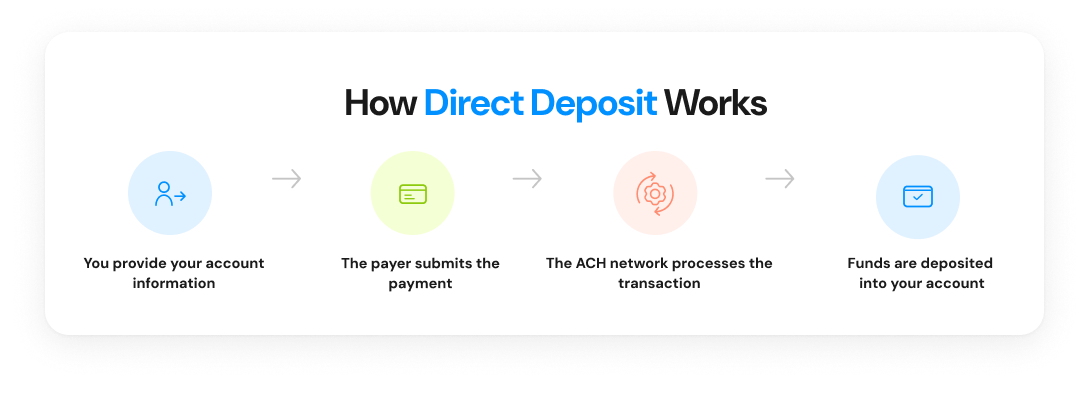
- You provide your account information: Your employer or payment provider will collect the routing and account numbers needed to send funds electronically to you
- The payer submits the payment: The payment is scheduled and transmitted through the Automated Clearing House (ACH) network before the deposit date, which is a system that connects financial institutions across the country
- The ACH network processes the transaction: The system verifies and routes the payment to the appropriate financial institution
- Funds are deposited into your account: The money is credited to your checking or savings account on the designated payment date
For account holders, the process is largely automatic. Once direct deposit is set up, payments continue to be delivered electronically until you update your banking information or make a change with the payer.
How Do You Set Up Direct Deposit?
Setting up direct deposit is usually a straightforward process. Whether you’re enrolling through a new employer, switching banks, updating your payment information, opening your first bank account or signing up to receive government benefits, you’ll need a few basic account details to get started.
- Gather information: Collect your checking or savings account number, your credit union or bank’s routing number, the type of account where you want funds deposited and the direct deposit authorization form. The routing number is a 9-digit code tied to your specific bank, while your account number is a number tied to your personal bank account, which can be found on the bottom of a physical check or in your online bank account
- Complete the direct deposit authorization form: Using the information you’ve gathered, provide the account information where you’d like your payments to be deposited. Make sure to review all numbers carefully, as even a small error can delay your deposit. Most places now have an online form rather than a physical form you can complete for this step
- Submit the required information: Submit online or return the completed form to your employer, benefits administrator, government agency or other payment provider
- Wait for enrollment to be processed: Direct deposit setup is not always immediate. Depending on the payer’s payroll or payment schedule, it may take one or more payment cycles before direct deposit becomes active
- Confirm your first deposit: Once enrollment is complete, monitor your account around the expected payment date. If you don’t see the deposit when expected, contact the payer to verify the status of your enrollment
What Are the Benefits of Direct Deposit?
Direct deposit has become a preferred payment method for employers, government agencies and account holders alike. By eliminating paper checks and automating deposits, it offers several advantages that can make managing your finances more convenient:
- Get paid faster: Funds are deposited directly into your account on the scheduled payment date, eliminating the wait associated with receiving and depositing a paper check
- Greater convenience: Your money is deposited automatically, so there’s no need to visit a branch, ATM or mobile banking app to complete a deposit
- Reduce the risk of lost or stolen checks: Because payments are delivered electronically, there’s no paper check that can be misplaced, damaged or intercepted in the mail
- Make saving easier: Many employers allow you to split direct deposits between multiple accounts, making it simple to automatically direct a portion of each paycheck into various types of savings accounts
- Keep better track of your finances: Electronic deposits create a clear transaction history that can be viewed through online or digital banking, making it easier to monitor income and manage your budget
How Long Does a Direct Deposit Take to Hit Your Account?
In most cases, direct deposit funds are available in your account on the scheduled payment date. The exact timing can vary depending on the payer, the payment schedule and your financial institution’s processing practices.
If you’re setting up direct deposit for the first time, enrollment can take a little longer. Some employers can activate direct deposit within a few business days, while others may require one to two pay periods before electronic payments begin. During the transition, you may continue to receive paper checks until your enrollment is finalized.
Why Choose California Credit Union for Direct Deposit
At California Credit Union, we offer our members a seamless banking experience. One of the benefits of a credit union is the member-focused approach to banking, and at California Credit Union, we help you access your money sooner and take advantage of valuable account benefits.
- Get paid up to one day early*: Eligible direct deposits may be available in your account up to one day before your scheduled payday, giving you quicker access to the money you’ve earned
- Earn a $250 checking account bonus: When you open an eChecking account and meet qualifying direct deposit requirements, you may be eligible for a $250 bonus. It’s an easy way to put extra money in your pocket while setting up a service you may already use
- Access your money anytime: Monitor deposits, check balances, transfer funds and manage your account through online and mobile banking whenever it’s convenient for you and enjoy a convenient digital wallet to make purchases directly from your device
- Build better financial habits: Direct deposit makes it easier to automate savings, stay on top of bills and maintain a clearer picture of your cash flow throughout the month
- Bank with a financial institution that puts members first: As a member-focused credit union, we’re committed to helping you make the most of your money with convenient services, competitive products and personalized support
Ready to make the switch? Opening an eChecking account and enrolling in direct deposit can be completed in just a few steps. Learn how to open a bank account and see how easy it can be to get paid sooner, manage your money with confidence and potentially qualify for a $250 bonus.
Wrapping Up: Setting Up Direct Deposit
Direct deposit takes the hassle out of receiving payments by sending your money straight to your account electronically. Whether you’re receiving a paycheck, government benefits or other recurring payments, it offers a convenient and secure way to access your funds. By setting up direct deposit with California Credit Union, you can spend less time managing deposits and more time focusing on your financial goals. Plus, eligible members may be able to access their paychecks up to one day early and take advantage of available checking account offers.
*We will post your direct deposit to your account as soon as we receive it from the source or your employer.