
What Is an SBA Loan? What They Are, How They Work & How to Qualify
Last updated on August 24, 2026
SBA loans can help eligible small businesses access affordable financing for startup costs, expansion, equipment and working capital.
- SBA loans are partially guaranteed by the U.S. Small Business Administration, helping eligible businesses qualify for financing
- SBA 7(a), 504, Microloans and Disaster Loans each support different business needs
- Competitive rates, lower down payments and longer repayment terms can make SBA loans more affordable than some conventional business loans
- SBA loan funds can be used for day-to-day expenses, equipment purchases, business expansion, refinancing debt and more
- Working with an SBA-approved lender or credit union can help simplify the process
Learn how SBA loans can help eligible small businesses access flexible, affordable financing.
An SBA loan is a small business loan partially guaranteed by the U.S. Small Business Administration, helping eligible businesses access affordable financing through approved lenders. To qualify, businesses must typically meet SBA size standards, operate for profit and demonstrate the ability to repay the loan.
Securing financing is often one of the biggest hurdles a small business will face. Whether you’re opening a new location, replacing aging equipment or simply covering day-to-day operating expenses, having access to affordable capital can make all the difference. That’s where an SBA loan comes in. Backed in part by the U.S. Small Business Administration and offered through approved lenders like California Credit Union, these loans can make financing more accessible by offering competitive rates, lower down payment requirements and longer repayment terms than many conventional business loans.
In this guide, we’ll break down how SBA loans work, who qualifies and which program fits your needs, so you can move forward with greater confidence and make informed decisions for your business.
Key Takeaways
- SBA loans are offered by eligible lenders and guaranteed by the U.S. Small Business Administration (SBA), offering flexible financing options with competitive interest rates, lower down payments and longer repayment terms for eligible small businesses
- Several SBA loan programs are available, including 7(a), 504, Microloans and Disaster Loans, each designed to support different business financing needs
- Qualifying for an SBA loan typically requires meeting SBA size standards, operating a for-profit business and demonstrating the ability to repay the loan
What Is an SBA Loan?
An SBA loan is a small business loan offered by participating lenders and partially guaranteed by the U.S. Small Business Administration (SBA). That guarantee helps reduce the lender’s risk, making it possible for many businesses to qualify for financing with competitive interest rates, lower down payment requirements and longer repayment terms than conventional loans.
Despite the name, the SBA doesn’t lend money directly for most loan programs. Instead, banks and credit unions, like California Credit Union, provide the funds while the SBA guarantees a portion of the loan. If a borrower defaults, the SBA covers part of the lender’s loss, which encourages lenders to work with businesses that might not qualify for traditional financing alone.
What Are the Different Types of SBA Loans?
The SBA offers several loan programs, each designed to meet different business needs. Some are built for everyday operating expenses, while others focus on long-term investments like commercial real estate or equipment purchases.
SBA 7(a) Loan
The SBA 7(a) loan is the agency’s most popular financing program because of its flexibility. Businesses can use the funds for working capital, purchasing equipment, buying inventory, refinancing eligible debt, acquiring another business or even purchasing commercial real estate. If your financing needs span multiple areas, a 7(a) loan is often the first program worth exploring.
SBA 504 Loan
An SBA 504 loan is designed for major, long-term investments that help a business grow. These loans are commonly used to purchase owner-occupied commercial property, construct new facilities or finance large equipment purchases. Because they’re intended for fixed assets, 504 loans typically offer long repayment terms and fixed interest rates, making it easier to budget for significant investments.
SBA Microloan
For newer businesses or those with smaller funding needs, an SBA Microloan may be a good fit. These loans provide smaller amounts of financing, which is $50,000 or less, that can be used for working capital, inventory, furniture, fixtures or equipment. Many startups and entrepreneurs turn to microloans when they need enough capital to get established without taking on a larger loan than necessary.
SBA Disaster Loans
When a federally declared disaster disrupts business, SBA Disaster Loans can help cover recovery costs. There are a few different types of disaster loans, and eligible businesses may use these funds to repair or replace damaged real estate, equipment, inventory and other essential business assets. In some cases, disaster loans can also help businesses meet financial obligations while recovering from lost revenue.
Which SBA loan is right for your business?
The best SBA loan depends on what you’re trying to accomplish. If you need flexible financing for day-to-day operations or expansion, a 7(a) loan is often the strongest option. Businesses purchasing property or large equipment may benefit more from a 504 loan, while startups with modest financing needs may find a microloan to be a better fit. If your business has been affected by a federally declared disaster, an SBA Disaster Loan can provide financial relief during the recovery process.
SBA Loan Type | Best For | Common Uses |
SBA 7(a) Loan | General business financing | Working capital, expansion, equipment, inventory, refinancing debt, commercial real estate |
SBA 504 Loan | Long-term fixed assets | Commercial property, construction, major equipment purchases |
SBA Microloan | Startups and small financing needs | Working capital, inventory, supplies, furniture and equipment |
SBA Disaster Loan | Disaster recovery | Repairing or replacing business property, equipment and inventory after a declared disaster |
What Are the Benefits of SBA Loans?
SBA loans can provide small businesses with access to financing options that may be more flexible than traditional business loans. Here are a few potential benefits:
- Lower down payments: Many SBA loan programs require less money upfront than some conventional business loans, helping businesses preserve cash for daily operations, hiring, inventory and other expenses
- Competitive interest rates: SBA loans often come with competitive interest rates because the SBA guarantee reduces risk for participating lenders, which can help businesses keep borrowing costs more manageable
- Longer repayment terms: Extended repayment periods can lower monthly payments and give businesses more time to repay the loan while maintaining healthy cash flow
- Flexible use of funds: Depending on the loan program, SBA financing can be used for a variety of business needs, including equipment purchases, working capital, real estate, inventory and expansion
- Higher borrowing limits: SBA loans can provide access to larger amounts of capital than many small business financing options, making them useful for major investments and long-term growth plans
- Easier qualification than some conventional loans: The SBA guarantee can make lenders more willing to work with qualified businesses that may not meet every requirement of traditional financing options
What Are SBA Loan Eligibility Requirements?
To qualify for an SBA loan, a business must meet requirements set by the Small Business Administration and the participating lender. While eligibility can vary depending on the loan program, lenders generally look for businesses that are financially stable, have a clear purpose for funds and can demonstrate the ability to repay the loan.
Most businesses seeking SBA financing must meet the following criteria:
- Operate as a for-profit business: SBA loans are generally available to for-profit businesses operating in the United States or its territories. Nonprofit organizations, certain financial businesses and other ineligible industries may not qualify
- Meet SBA size standards: The SBA provides financing specifically for small businesses, so companies must meet size standards based on factors such as industry, annual revenue or number of employees. They have a free size standards tool to help you determine your eligibility
- Have a clear business purpose for the funds: Applicants must explain how they plan to use the loan. Common approved uses include purchasing equipment, expanding operations, buying commercial real estate, managing working capital or refinancing eligible business debt
- Demonstrate the ability to repay the loan: Lenders review your business financials, cash flow, credit history and other factors to determine whether your business can comfortably manage loan payments
- Have a strong credit history: Both business and personal credit history may be considered during the application process. A solid credit profile with a good credit score can help demonstrate financial responsibility and improve overall chances
- Provide required documentation: Applicants typically need to provide financial records and business information, such as tax returns, bank statements, profit and loss statements, balance sheets, business licenses and a business plan when applicable
What Can SBA Loans Be Used For?
SBA loans can be used for a wide range of business expenses, from everyday operating needs to major investments that support long-term growth. The specific uses depend on the type of SBA loan you choose, but common purposes include:
- Starting a business: Cover startup costs such as equipment, inventory, supplies and initial operating expenses
- Purchasing equipment: Buy machinery, technology, vehicles or other tools needed to run and grow your business
- Expanding operations: Fund a new location, increase production capacity or invest in business improvements
- Buying commercial real estate: Purchase or renovate owner-occupied business property
- Managing working capital: Cover payroll, rent, inventory, marketing and other ongoing business expenses
- Refinancing eligible debt: Replace certain existing business debt with more favorable repayment terms
- Purchasing an existing business: Finance the acquisition of an established company
- Recovery after a disaster: Repair or replace business property, equipment and inventory after eligible disasters
How Do You Apply for an SBA Loan?
Applying for an SBA loan involves several steps, from identifying your funding needs to completing the lender’s review process. While requirements can vary by lender and loan program, most businesses will follow a similar path:
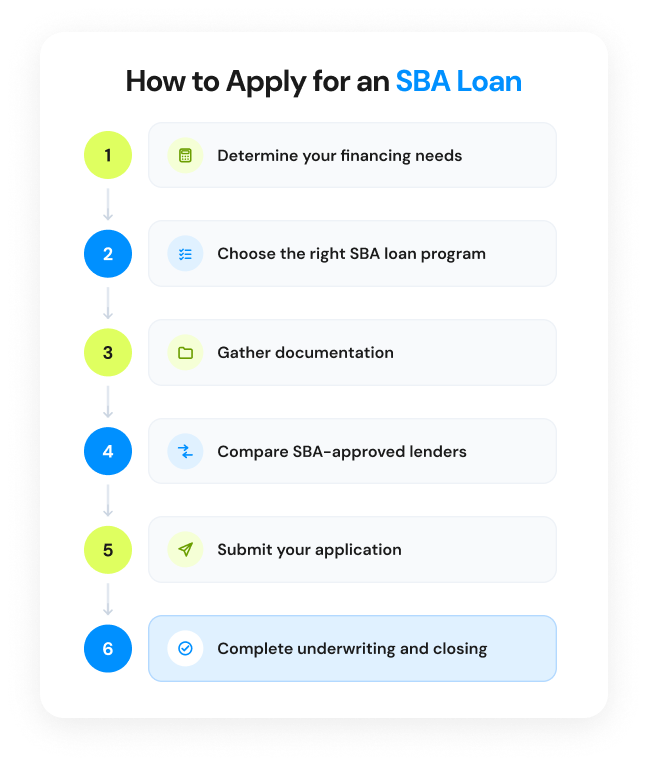
- Determine your financing needs: Start by deciding how much funding you need and how you plan to use the loan. Having a clear purpose helps you choose the right financing option and avoid borrowing more than necessary
- Choose the right SBA loan program: Review available SBA loan options, such as 7(a), 504 and Microloans, to find the program that best matches your business goals and funding needs
- Gather documentation: Prepare important business records, including financial statements, tax returns, bank statements, business licenses and other information your lender may request
- Compare SBA-approved lenders: Different lenders may offer different experiences, requirements and timelines. Comparing SBA-approved lenders and banks vs. credit unions can help you find a financing partner that understands your business
- Submit your application: Complete your loan application and provide the required documentation. Your lender will review your financial information, business history and loan purpose
- Complete underwriting and closing: During underwriting, the lender evaluates your application and determines whether your business qualifies. If approved, you’ll finalize the loan documents and receive your funds
What Is the Difference Between an SBA Loan and a Conventional Business Loan?
The main difference between an SBA loan and a conventional business loan is the level of government support involved. SBA loans are issued by approved lenders and partially guaranteed by the U.S. Small Business Administration, while conventional business loans are funded entirely by the lender without an SBA guarantee.
Compared to SBA loans, conventional business loans typically have fewer government requirements and may offer a faster application process, but lenders often rely more heavily on factors such as credit history, revenue and available collateral when making approval decisions.
SBA Loans vs. Conventional Business Loans | ||
Feature | SBA Loan | Conventional Business Loan |
Government guarantee | Partially guaranteed by the SBA | No government guarantee |
Qualification | May offer more flexibility for eligible businesses | Often requires stronger financial qualifications |
Down payment | May require a lower down payment | Requirements vary by lender |
Repayment terms | Typically longer repayment options | Terms vary by lender |
Best for | Businesses seeking flexible financing options | Businesses with strong credit and established financials |
Wrapping Up: Finding the Right SBA Loan for Your Business
From starting a new venture to expanding your operations or investing in the future of your business, an SBA loan can provide flexible financing to help you reach your goals. Understanding the available SBA loan programs, eligibility requirements and application process can help you choose the financing solution that best fits your needs and position your business for long-term success.
Looking for more resources? Explore our business planning tools for guidance on building a strong foundation for growth, and discover our business banking solutions designed to help you manage your finances with confidence at every stage of your business journey.