

What Happens When A Share Certificate Matures?
Last updated on November 19, 2026
When a share certificate matures, you gain access to your original deposit plus all earned dividends with no withdrawal penalty. You can choose to withdraw or transfer the balance, or roll the funds over into a new share certificate. If you do nothing, most credit unions automatically renew your share certificate.
- Share certificates mature when they reach the designated date agreed upon when you set up the share certificate, known as the maturity date
- When a share certificate matures, you have 7 to 10 days to roll it over, transfer the money, change the term length, or add or withdraw capital
- Interest earned from share certificates is taxed similarly to bank interest, and you’ll receive a 1099-INT or 1099-DIV from your financial institution
- Before a share certificate matures, you should start planning out what you’re going to do when it reaches maturity
Learn about the 7–10 day grace period, automatic rollover rules, tax implications and what to do next.
When a share certificate matures, you gain access to your original deposit plus all earned dividends with no withdrawal penalty. You can choose to withdraw or transfer the balance, or roll the funds over into a new share certificate. If you do nothing, most credit unions automatically renew your share certificate.
Key Takeaways
- Share certificates mature when they reach the designated date agreed upon when you set up the share certificate, known as the maturity date
- When a share certificate matures, you have 7 to 10 days to roll it over, transfer the money, change the term length or add or withdraw capital
- Interest earned from share certificates is taxed similarly to bank interest, and you’ll receive a 1099-INT or 1099-DIV from your financial institution
- Before a share certificate matures, you should start planning out what you’re going to do when it reaches maturity
Share certificates, also known as Certificate of Deposits (CDs) at banks, are a smart way to make your money work for you. As long as you have money you can keep in savings for a while, you can get a guaranteed return.
While share certificates are a type of savings account, they’re different from traditional savings accounts because they have to mature before you can access them. Find out what happens when a share certificate matures and what you can do next.
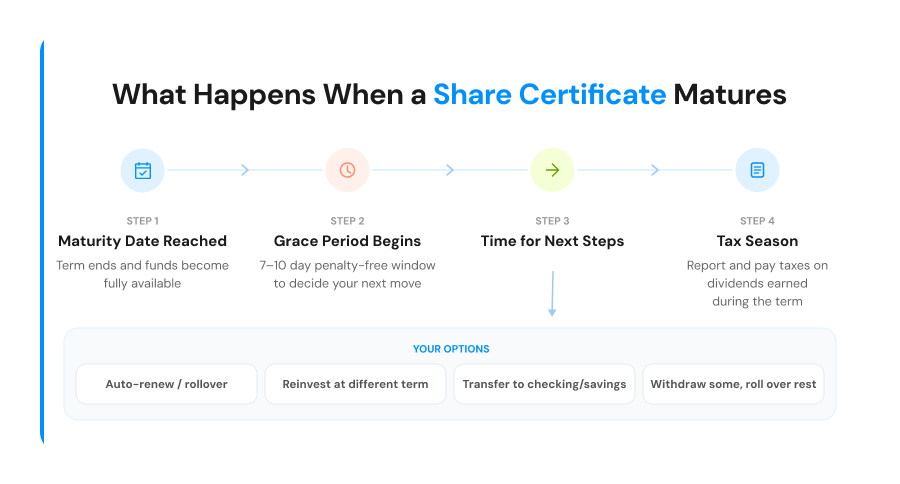
What Is Share Certificate Maturity?
A share certificate is a type of fixed-term savings account offered by credit unions that works similarly to a traditional bank’s certificate of deposit (CD). You deposit a set amount into the account and decide how long you want to leave it, earning a fixed dividend rate on the original balance until the maturity date.
The share certificate maturity date is the date when the agreed-upon term ends and funds become fully available without early withdrawal penalties (EWPs). The maturity date can be anywhere from three months to five years, and you get to choose how long you want to leave your money in the account.
Principal and earned dividends remain NCUA-insured up to $250,000, so you’re not putting your money at risk even with a five-year maturity date.
The Grace Period: Your Time to Act
When a share certificate matures, the grace period begins. The standard grace period for most credit unions is 7 to 10 days.
This grace period is important because it’s your window of time to act after your share certificate matures. During this time, you can move, withdraw or adjust funds with no penalties. You have access to your original deposit and all of your dividends during the grace period.
You can also choose to renew your share certificate when the grace period begins. If you don’t withdraw your money or transfer it to another account within the grace period, the funds will roll over, and you’ll be locked in for another term.
What You Can Do When a Share Certificate Matures
When a share certificate matures, you have an important decision to make. Planning ahead can help you prepare for the moment your share certificate matures so you don’t have to figure it out at the last minute.
Auto-renew or rollover
Once a share certificate matures and you have access to your original deposit and dividends, you can choose to roll those funds over into a new share certificate. You don’t have to stick with the same terms when you roll your share certificate over into another term.
If you don’t take any action within the grace period after your share certificate matures, it will automatically renew. In the event of an auto-renewal, your new share certificate will be the same length as your previous one and will use the current prevailing interest rate.
When it makes sense:
- You can leave the funds untouched without impacting your monthly finances
- Rolling over into a new term aligns with your financial goals
- Current interest rates beat other safe investment options
When to consider another route:
- Your credit union offers better rates on other safe options
- Rates are climbing rapidly, and you don’t want to lock in for an extended period
- You need access to the cash in the immediate future

Change the term length
You can also choose to change the term length of your share certificate if you still want to invest but don’t want to renew your previous share certificate. For example, you can change from a 13-month certificate to a 6-month certificate so you don’t have to wait as long to access your deposit and dividends.
You can also choose to extend your term length if your credit union offers longer terms. Longer terms typically come with better interest rates, but they can also lock a portion of your money up for several years.
When it makes sense:
- Interest rates are climbing quickly, and you want to renew at higher rates every few months
- You previously had a years-long term length and no longer want your money tied up for that long
- You want to lock into a longer term to access higher interest rates
When to consider another route:
If you’re already happy with your current term length, it likely doesn’t make sense to make any changes.
Transfer to your savings or checking account
You have full access to the funds in a share certificate once it matures, which means you can transfer those funds to your savings or checking account. Credit unions make this process easy because your share certificate is tied to your other accounts, so you can transfer money in seconds.
Transferring money to your everyday bank accounts gives you access to funds for bills, emergency expenses and everyday essentials.
When it makes sense:
- You need access to the money in your share certificate
- You no longer want to tie up your money in a share certificate
- You can transfer those funds to a higher-yield safe investment
When to consider another route:
- You want to renew your share certificate
- You want to roll over partial funds to another share certificate

Add or withdraw capital
If your share certificate matures and you don’t want to withdraw everything or roll all of the funds over, you can also add or withdraw capital. Withdrawing capital is a smart way to give yourself access to more of your money without getting rid of your share certificate entirely.
If you want to maximize your returns on your share certificate and don’t need immediate access to all your money, you can add funds to increase the dividends you earn on your next share certificate.
When it makes sense:
- You want to reduce the amount you contribute to your next share certificate
- You want to increase the amount you contribute to your next share certificate
When to consider another route:
- You want to roll over all the funds in your share certificate
What Happens If You Do Nothing?
If you don’t take any action during the 7- to 10-day grace period that most credit unions offer after a share certificate matures, it will typically renew automatically. Your original deposit plus dividends rolls over into a new share certificate with the same term length, but the interest rate will be based on the current prevailing interest rate.
The main disadvantage of allowing your share certificate to renew automatically is that you lose your lock-in rate, which may be higher than the current APY on maturity day.
Tax Rules for Maturing Share Certificates
Maturing share certificates are taxable dividends, but they’re treated similarly to bank interest for tax purposes.
Earnings from share certificates are taxable in the year they’re credited, even if they’re rolled over into a new term. You’ll receive a 1099-INT or 1099-DIV from your credit union by January 31 in the year after the tax year when you earned dividend income. But keep in mind, even if you don’t receive one of these forms, you’re responsible for reporting this income on your return.
IRA-backed share certificates follow separate tax-deferred or tax-free withdrawal rules, allowing you to take full advantage of the benefits of share certificates.
What to Do Before Your Share Certificate Matures
If your share certificate is maturing soon, here’s what you should do before it matures:
- Check the maturity date
- Mark the grace period on your calendar
- Review auto-renewal terms
- Assess your cash needs to determine if you need access to share certificate funds
- Compare rates from competitors to make sure you’re choosing the right share certificate
Wrapping Up: Take Control of Your Maturing Certificate Today
Investing in share certificates can be a smart move if you have extra cash you don’t need immediate access to. Share certificates are a low-risk option, making them an excellent choice for risk-averse investors.
California Credit Union makes it easy to invest in share certificates with flexible terms and competitive interest rates. If you’re looking to make more money than the dividends from your standard savings account can provide, but want to avoid the risks of investment, a share certificate may be the savings solution for you.