

Benefits of Share Certificates: A Smart Way to Grow Your Savings
Last updated on July 20, 2026
Discover the benefits of share certificates.
Share certificates offer a secure way to grow your savings with a fixed dividend rate, predictable returns and protection from market swings. They can also provide higher earnings than many traditional savings accounts while helping you stay committed to long-term financial goals.
Whether you’re building a down payment fund for your first home or simply looking for a place to earn more on your savings, a share certificate can be a valuable tool. Unlike accounts with variable rates, share certificates lock in a dividend rate for a set term, giving you clarity about what your money can earn. For members who prioritize stability over uncertainty, a share certificate can be a great approach to saving that combines growth potential with peace of mind.
Key Takeaways
- Share certificates are a savings vehicle offered by credit unions that come with fixed dividend rates, allowing you to earn predictable returns over a set term
- Share certificates often provide higher earnings potential than traditional savings accounts in exchange for keeping funds on deposit until maturity
- Withdrawing funds from a share certificate before it reaches maturity can result in a penalty
- Funds held in share certificates at federally insured credit unions are protected up to $250,000 by the NCUA
- California Credit Union offers several different types of share certificates with varying term lengths to choose from
What Is a Share Certificate?
A share certificate is a type of savings account offered by credit unions that allows you to earn a fixed dividend rate on money you agree to leave on deposit for a specific period of time. Terms can range from a few months to several years, and the rate you receive is typically locked in when the certificate is opened.
Share certificates are similar to certificates of deposit (CDs) available through banks, but they reflect the cooperative structure of credit unions. Instead of earning interest, credit union members earn dividends, which are paid from the institution’s earnings, which is one of the main differences between a credit union and a bank.
When the certificate reaches maturity, you’ll have the option to withdraw your funds, renew the certificate for another term or move the money into a different account. Because funds are intended to remain untouched during the term, share certificates often offer higher rates than traditional savings accounts, offering savers a balance between growth, stability and security.

How Do Share Certificates Work?
A share certificate allows you to deposit money with a credit union for a predetermined period of time, known as the term. In return, the credit union pays a fixed dividend rate on your deposit for the duration of the term. Because the rate is established when the account is opened, you’ll know exactly what your savings can earn before the certificate reaches maturity. The way share certificates work is simple:
- Choose a term based on your financial goals and timeline
- Deposit your funds into the share certificate
- Earn fixed dividends throughout the term
- Access, renew or transfer your funds when the certificate matures
If you’re looking for predictable growth without exposure to market fluctuations, share certificates offer a simple way to put your money to work while maintaining a clear timeline and expected return. You can use our free share certificate calculator to see how much you can earn based on your deposit, term length and APY.
What Are the Benefits of Share Certificates?
If you have money you won’t need right away, a share certificate can be a practical way to earn more from your savings. Instead of leaving those funds in an account with a variable rate that can change, you can lock in a fixed dividend for a set period and know exactly how your savings will grow. For many credit union members, it’s a simple option that offers stability without the ups and downs of the market.
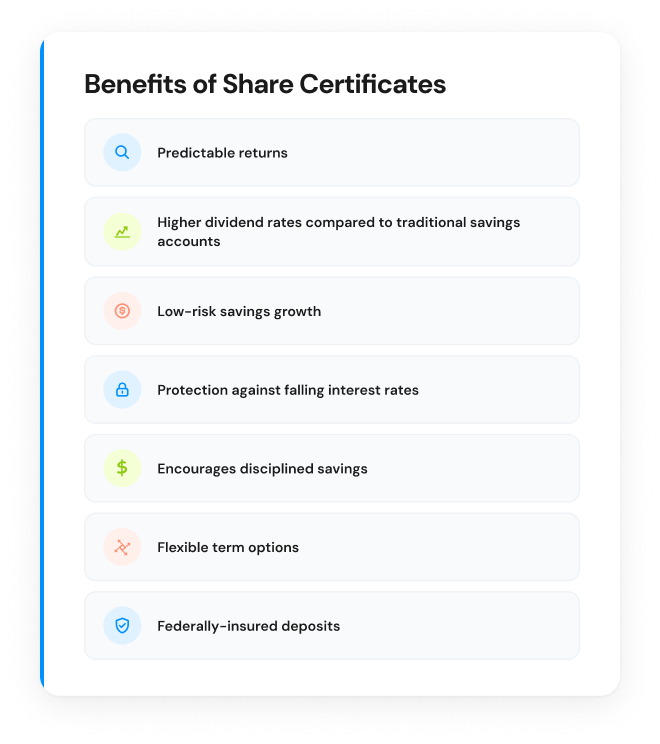
Predictable returns
With a share certificate, the dividend rate is set when you open the account and doesn’t change before the term ends. This means you don’t have to wonder how rate changes will affect your earnings. From day one, you know how long your money will stay on deposit and what it can earn by the time the certificate matures.
Higher dividend rates compared to traditional savings accounts
Credit unions often pay higher dividend rates on share certificates than they do on traditional savings accounts. In return, you agree to leave your money on deposit for a specified term. If you have savings you don’t plan to use for a while, that tradeoff can result in stronger earnings over time thanks to compounding interest than keeping those funds in a standard savings account.
Low-risk savings growth
Not every savings goal calls for investment risk. If preserving your principal is just as important as earning a return, a share certificate can be a good fit. Your balance isn’t affected by swings in the stock market, and your savings continue earning dividends throughout the term at the rate you locked in when the account was opened.
Protection against falling interest rates
Savings account rates can move up or down as market conditions change. Once you open a share certificate, however, your dividend rate stays the same until maturity. If rates drop a few months later, your certificate continues earning at the higher rate you originally secured, which can be especially valuable during periods of declining interest rates.
Encourages disciplined savings
If you’re wondering how to save money, many people find it easier to stay committed to a savings goal when the money is set aside and less accessible. Since withdrawing funds from a share certificate before maturity can result in a penalty, they create a natural incentive to leave your savings untouched. This structure can be especially helpful when saving for a specific milestone or planned expense.
Flexible term options
We all have different savings goals that have their own timelines, and one of the benefits of a share certificate is that they reflect that reality. Credit unions typically offer a range of terms, from a few months to several years, so you can choose one that lines up with when you’ll need access to your money. If you’re saving for an upcoming expense or planning well ahead, selecting the right term can help you make the most of your savings without locking up your funds longer than necessary.
Federally-insured deposits
When you open a share certificate at a federally insured credit union, your deposit is protected by the National Credit Union Share Insurance Fund (NCUSIF), administered by the National Credit Union Administration (NCUA), for up to $250,000. As one of the key benefits of a credit union, this means your money is backed by federal insurance while it still earns dividends, making share certificates a dependable choice for members who want to grow their savings without taking on market risk.
Wrapping Up: Saving With a Share Certificate
A share certificate can be a practical choice for savers who want steady growth without the uncertainty that comes with market-based investments. With fixed dividend rates, flexible term options and federally insured deposits, share certificates offer a straightforward way to put your money to work while keeping your savings goals in focus. At California Credit Union, we offer a range of share certificates with different term lengths between 3 and 60 months. Open a share certificate today to start working toward your financial goals.