

How to Open a Business Bank Account: Steps and Documents You Need
Last updated on November 10, 2026
To open a business bank account, you’ll need an Tax Identification Number (TIN) and your business formation documents.
- A business bank account keeps business and personal money separate
- Most banks and credit unions require a TIN, formation documents and a photo ID for each owner.
- California Credit Union offers four business checking options you can open online or in a branch
Learn how to open a business bank account, whether you're a sole proprietor or starting an LLC.
To open a business bank account, you'll need a Tax Identification Number (TIN) and your business formation documents. You'll also need a photo ID for each owner. From there, you can compare business checking accounts or business savings accounts and apply online or at a branch.
Here's what you need and how to get it done, whether you're a sole proprietor or starting an LLC.
Key Takeaways
- A business bank account keeps business and personal money separate
- Most banks and credit unions require a TIN, formation documents and a photo ID for each owner
- LLCs should open their own account as soon as you form the business
- California Credit Union offers four business checking options you can open in a branch
Why You Need a Separate Business Bank Account
As soon as your business starts earning or spending money, it needs its own account. That gives you:
- Liability protection: For LLCs and corporations, mixing business and personal money can put your personal assets at risk
- Simpler bookkeeping and taxes: When all business money runs through one account, it's easier to track income and deductions
- Room to grow: A business account opens the door to business credit cards, lines of credit and card payments
Once you're up and running, these tips for small business success can help you plan your next move.
What You Need to Open a Business Bank Account
Before opening an account, every bank or credit union checks who you are and that your business is real. Expect to share:
- Personal information: A government issued photo ID, your Social Security number and proof of address
- Business information: Your legal business name, address, business structure and TIN. Some business types need to apply for an Employer Identification Number (EIN). Getting an EIN is free, and you can apply for an EIN through the IRS in minutes
- Business documents: Formation documents, ownership agreements and any business licenses.
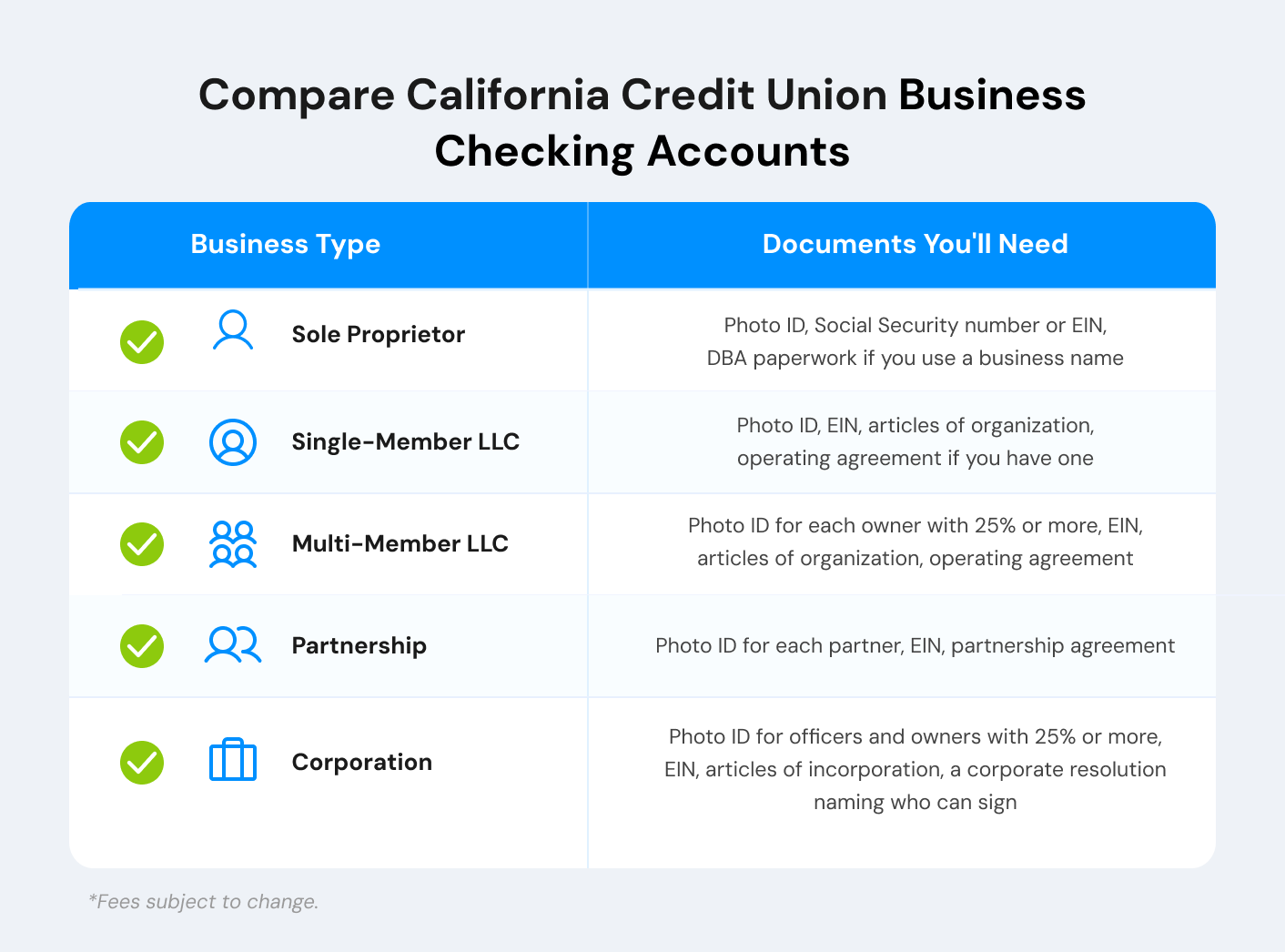
The exact documents depend on how your business is set up. For example, an LLC needs its Articles of Organization (LLC-1), an operating agreement and a Statement of Information, while a corporation needs its filed articles of incorporation and a corporate resolution. Review California Credit Union's full list of required documents to open a business account before you apply.
How to Open a Business Bank Account in 5 Steps
- Register your business. Choose your structure and register with your state if needed
- Get your TIN or EIN. It's free from the IRS, and you get your number right away once the IRS approves it
- Gather your documents. Having everything ready helps you avoid delays
- Compare accounts. Review fees, limits and digital banking tools
- Apply and fund the account. Apply online or at a branch, then make your opening deposit. Approval may take a few business days
How to Choose the Right Business Checking Account
Most new businesses start with business checking, then add a business savings account for taxes and cash reserves. When comparing business checking accounts, look at:
- Monthly fees: Check the fee and how to waive it
- Transaction and cash-deposit limits: Pick an account that fits your monthly volume
- Digital tools: Look for mobile deposits and bookkeeping software integration
- Branch access: If you handle cash, a nearby branch makes deposits easier
All four of California Credit Union's business checking accounts open with a $200 deposit. Here's how their monthly fees compare and how to waive them:
- Basic Business Checking: The $5 monthly fee goes away when you keep a $1,000 average daily balance or sign up for eStatements
- Premium Business Checking: Keep a $2,500 average daily balance to skip the $15 monthly fee. You can also earn dividends on balances over $50,000.
- Analyzed Business Checking: For businesses with heavy transaction activity or use of a broad range of our services
- Remote Deposit Checking: Keep a $50,000 average daily balance to skip the $35 monthly fee, and utilize our scanner for fast deposits with check image reports and history
Why Consider a Credit Union for Your Business Account
Credit unions are member-owned and not-for-profit, so they return earnings to members through lower fees and better rates. The National Credit Union Administration (NCUA) insures credit union accounts, just like the FDIC insures banks. Learn more about a bank vs. credit union and the benefits of a credit union.

Common Mistakes to Avoid When Opening a Business Account
- Mixing personal and business money: Even a few personal purchases make bookkeeping harder
- Paying for an EIN: The IRS provides EINs for free, so skip sites that charge a fee
- Ignoring account limits: Going over monthly limits can add fees
- Waiting too long: Open your account as soon as money starts coming in
Wrapping Up: Open Your Business Bank Account With Confidence
Opening a business bank account comes down to five steps. Register your business, get your EIN, gather your documents, compare accounts and apply.
California Credit Union offers four business checking accounts, and the solutions that many businesses find beneficial to their cash management and financial strategy. Explore business banking at California Credit Union to see how we support local businesses.